
Personas en búsqueda de empleo
Quieres cambiar de profesión e incorporarte al sector digital, incluso sin una base técnica. Te acompañamos paso a paso para adquirir los fundamentos, estructurar tu proyecto y apuntar a tu primer puesto.
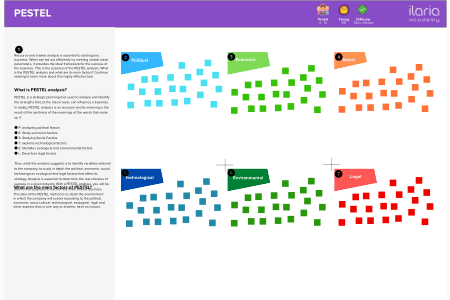
Resource and market analysis is essential to starting any business. When carried out efficiently by meeting certain basic parameters, it provides the ideal framework for the success of the business. This is the essence of the PESTEL analysis. What is the PESTEL analysis and what are its main factors? Continue reading to learn more about this highly effective tool.
PESTEL is a strategic planning tool used to analyze and identify the strengths that, at the macro level, can influence a business. In reality, PESTEL analysis is an acronym and its meaning is the result of the synthesis of the meanings of the words that make up it:
Thus, what this analysis suggests is to identify variables external to the company, to study in depth the political, economic, social, technological, ecological and legal factors that affect its strategy. Analysis is essential to determine the real chances of success in a given industry. With a PESTEL analysis, you will be able to find solutions to each of the limits of your business.
The idea of the PESTEL method is to detail the environment in which the company will evolve according to the political, economic, socio-cultural, technological, ecological, legal and other aspects that, in one way or another, have an impact.
Let us examine in more detail the factors taken into account in the PESTEL analysis:
This section includes elements such as policies developed in the country, environmental poverty levels, inequality indices, economic development, access to resources of its inhabitants, as well as how all this affects the activities of the enterprise.
The PESTEL description should include issues such as culture, religion, shared beliefs, imaginary, social classes and gender roles. In some cases, they are complementary to economic factors. The more defined the company in which the new enterprise is integrated, the more likely it is to succeed.
It is not the same thing to open a business in Amsterdam as in India. Opportunities for people to access IT tools, the management of the Internet, or the level of coverage of certain services largely determine the scope of a business and its potential for integration into the environment.
Each site has established laws that must be respected. It is the responsibility of companies to comply with it and to act within the framework they establish. However, it is also necessary to know the legislation on factors that may influence the course of the project, such as those related to consumption habits, social roles, freedoms or state intervention, among others.
These are elements directly or indirectly related to the preservation of the environment and the environment. For example, the effects of climate change, the level of pollution, the likelihood of suffering natural disasters, fires, earthquakes, tidal wave, among others. And, of course, the legislation that governs the activity of enterprises in this area, especially if the company has direct contact with natural resources or raw materials.
Nuestro asistente le orienta hacia la formación adecuada, las opciones de financiación y el nivel de acompañamiento que necesita.
Una metodología diseñada para que estés listo para el trabajo rápidamente: cursos en directo, acompañamiento personalizado, recursos en línea, IA y aplicaciones móviles al servicio de tu progreso.

Sigue sesiones interactivas en directo con formadores y haz tus preguntas para seguir progresando. ¿No pudiste asistir? Habrá un replay disponible para no perderte nada.
Benefíciate de sesiones de coaching en grupos reducidos y de citas individuales para desbloquearte, estructurar tu proyecto y mantener el rumbo.
Trabaja en casos reales del sector digital: sitios web, campañas de marketing y proyectos emprendedores, para construir un portfolio y obtener una experiencia real.
Accede a recursos estructurados (materiales, replays, guías prácticas) y aprende a usar la IA como herramienta para ahorrar tiempo y mejorar tus competencias.
Progresa en cualquier lugar y en cualquier momento gracias a nuestras aplicaciones móviles dedicadas a cada programa (seguimiento del progreso, prácticas, recordatorios y contenidos complementarios).
Prepárate para los exámenes con simulacros, feedback detallado y acompañamiento hacia unas prácticas o un proyecto freelance para validar tus competencias.
Quieres cambiar de profesión e incorporarte al sector digital, incluso sin una base técnica. Te acompañamos paso a paso para adquirir los fundamentos, estructurar tu proyecto y apuntar a tu primer puesto.
Ya estás trabajando y quieres hacer evolucionar tu carrera, asegurar tu empleo o preparar una transición hacia un rol más digital. Aprende a tu ritmo sin interrumpir tu actividad.
Estás en formación inicial o acabas de obtener tu diploma, y quieres adquirir competencias prácticas y operativas para impulsar tu empleabilidad en el sector digital.
Vives en el extranjero y quieres seguir una formación a distancia reconocida, con la posibilidad de realizar tus exámenes en línea o en alguno de nuestros campus según tu situación.
Accede a los replays completos de nuestras promociones anteriores a un precio más accesible y progresa a tu ritmo cuando no puedas incorporarte a la próxima convocatoria.
Estas empresas contratan por las competencias que enseñamos: Extia · Phenomenix · eNcloud Services LLC · yellowshark® AG · SII Germany · Cyberr · Devoteam | Cyber Trust · NSI Luxembourg PSF · MrBeast · OK JOB SA · Infosys · Banque de France · ARHS Group · weplace® · ALTEN · Twine · TotalEnergies · Klanik · NTT DATA Europe & Latam · Jack & Jill · GPD Group · Kicklox · UST · Amazon Web Services (AWS) · Julius Baer